Vams Beauty x Shopify
A Marketplace for Australian Women-Owned Beauty Brands
The Brief
Vams Beauty is an Australian beauty marketplace exclusively stocking women-owned brands across skincare, makeup, body, and fragrance. The founder wanted a storefront that gave each partner brand the editorial weight it deserved while letting buyers shop seamlessly across the catalog. We designed and built the marketplace, integrated payments and loyalty, and continue to onboard new brands monthly.
The home of Australian beauty.
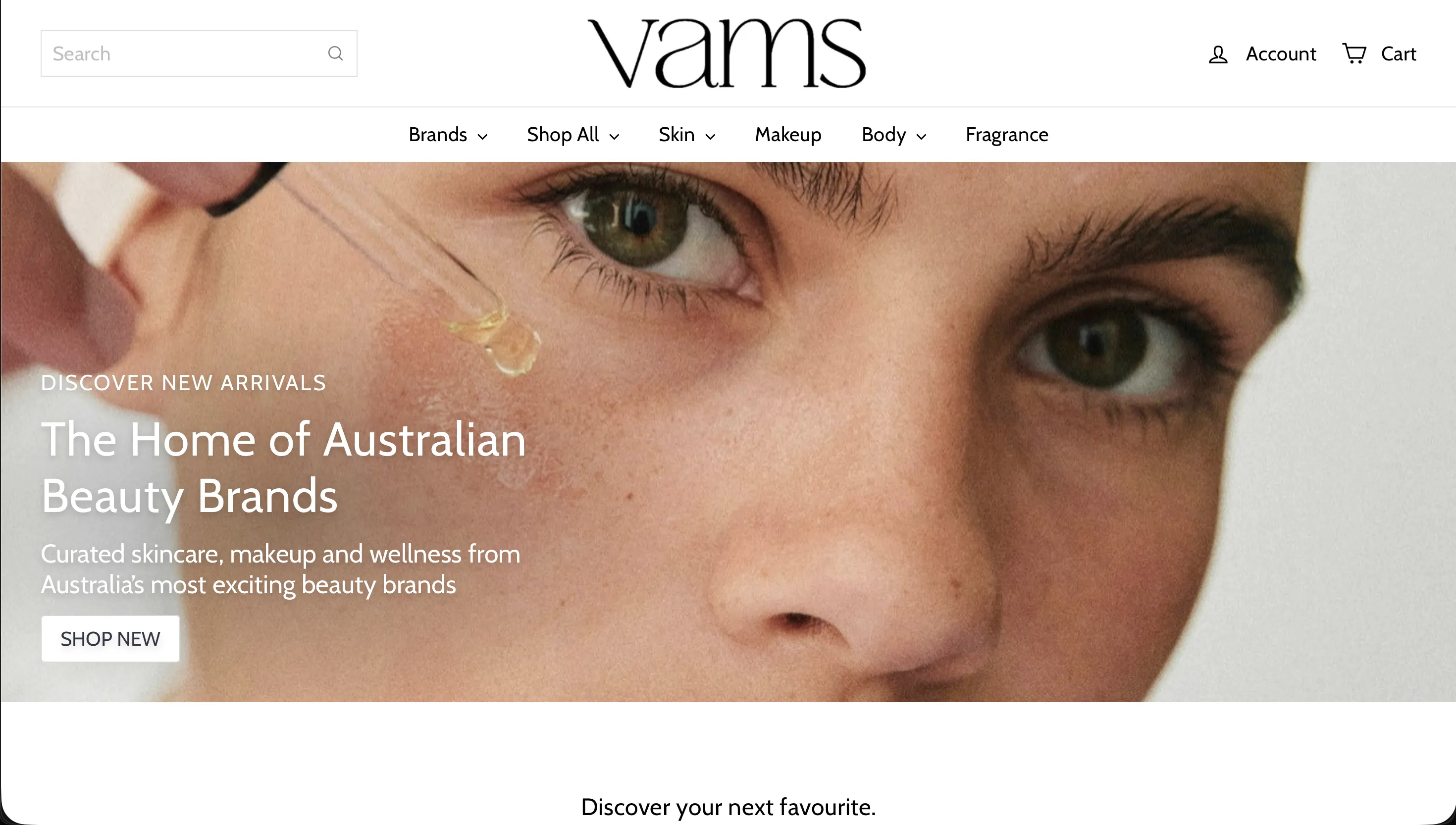
The homepage hero leans into editorial photography and a quiet positioning statement that signals to the buyer exactly what makes Vams different from a generic beauty retailer. Discovery flows toward brands first, products second, which is unusual for the category and exactly right for the customer.
Built by women. Curated for everyone.
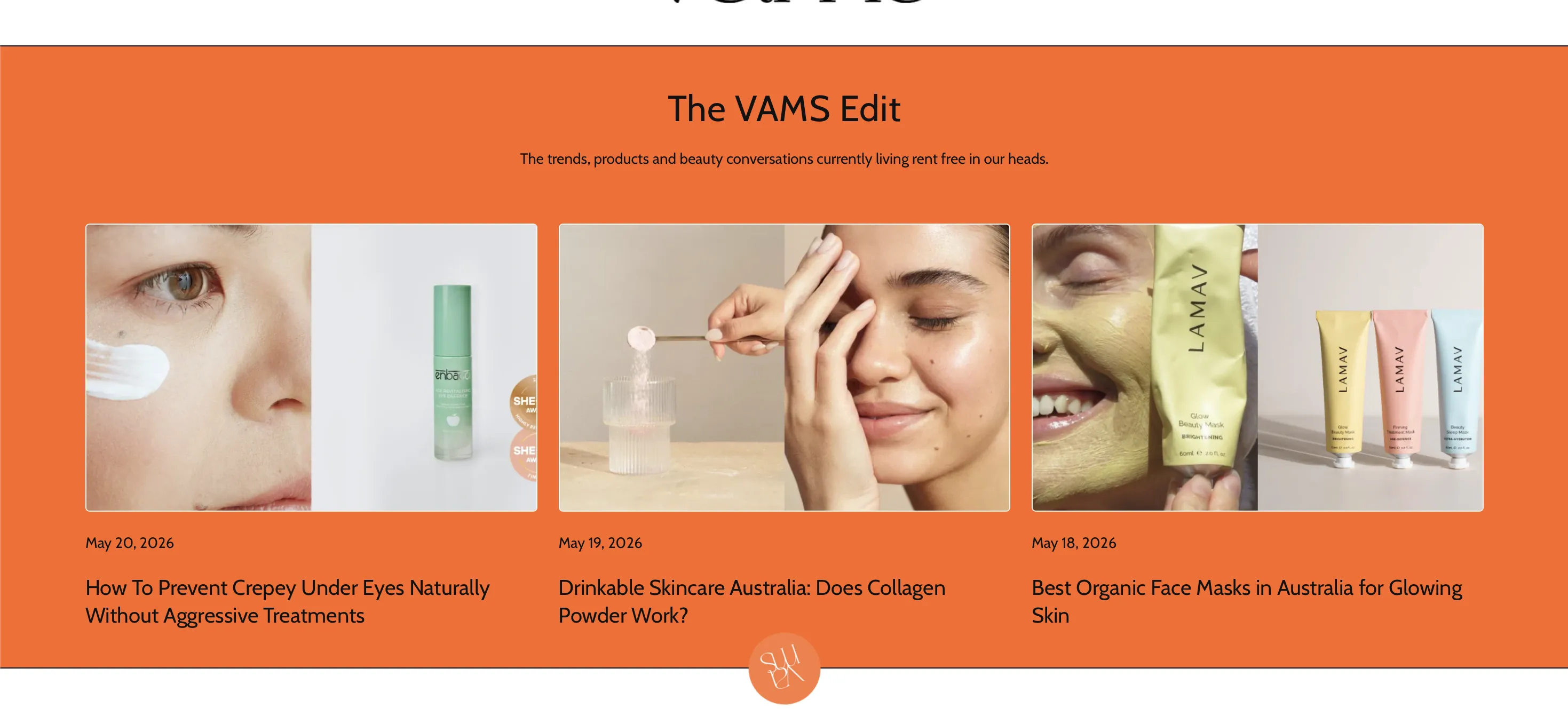
A dedicated brand storytelling section runs across the site, with imagery that puts the founders behind the products front and center. This is the editorial backbone of Vams: the brand exists to amplify the women who built each of the brands stocked on the shelf.

Product pages that respect the brand within.
Each partner brand has a consistent product page format that still feels native to their identity. Reviews, hero shots, ingredient transparency, and afterpay options sit in the same places on every product, so the buyer never has to relearn the page.

Building a curated marketplace for women-owned Australian beauty brands
Vams Beauty is a marketplace with a specific editorial point of view: every brand on the shelf is women-owned, Australian, and curated by the Vams team for quality and brand fit. That positioning makes the brand structurally different from the larger beauty marketplaces it competes with. The challenge in the build was giving each partner brand the editorial weight it deserved as an independent business, while keeping the Vams customer journey coherent across the catalog.
Why marketplace design is harder than single-brand design
Single-brand ecommerce has one identity to express, one voice, one set of visual conventions. The buyer arrives, learns the brand, and moves through the funnel. Marketplace ecommerce has two competing imperatives: the marketplace itself needs a coherent identity (so customers know they are at Vams), and each individual brand needs identity space (so customers do not feel like they are shopping at a homogenized retailer).
Most beauty marketplaces resolve this tension by flattening the partner brands into a uniform house style. The result is that the marketplace gains coherence but the partner brands lose identity, which over time turns the marketplace into a discount aggregator rather than a curation source. Vams resolves it the other way: the marketplace voice is intentionally restrained so each partner brand can express itself within a shared frame.
The marketplace identity
The Vams brand identity is built around editorial restraint. A muted palette, generous whitespace, photography-led storytelling. The voice is curatorial rather than promotional: "we found these brands, they meet our standards, you can trust the selection." This works specifically because the partner brands are not restrained, and the contrast makes each brand land more vividly when the buyer enters its product space.
The visual identity does specific work to position Vams against the alternatives. The mass-market beauty marketplaces lean loud and promotional. The premium independents lean very minimal and clinical. Vams sits in between: warm, considered, curatorial. It looks like a place that has a point of view rather than a place that sells everything.
The brand storytelling architecture
The brand storytelling section is the editorial backbone of the site. Each partner brand gets a dedicated brand page that profiles the founder, the founding story, the values that drive the formulation choices, and the products that flow from those values. The product page links back to this brand page, so buyers can move from "I want to try this" to "tell me about who made this" without leaving the customer journey.
This architecture works for Vams specifically because the value proposition of the marketplace is the curation, not the product alone. Customers come to Vams because they trust the Vams team to find brands worth knowing about. The brand storytelling reinforces that trust on every product they encounter.
The unified product page format
Despite each brand having its own editorial space, the product page format is consistent across the catalog. Reviews, hero shots, ingredient transparency, and Afterpay options sit in the same places on every product page. Buyers do not have to relearn the page when they cross from one brand to another. The brand's identity expresses through the photography, the copy voice, and the curated brand-specific recommendations, not through structural variation in the product page itself.
This consistency is what keeps the marketplace experience coherent at scale. As new brands onboard (the team onboards several new partner brands monthly), the product pages slot into the existing pattern without requiring custom design per brand. The visual identity of each brand carries through the photography while the page architecture stays predictable.
The discovery-flow choices
Most beauty marketplaces organize discovery around product category (skincare, makeup, fragrance, body). Vams adds a parallel discovery flow organized around brand. The homepage and main navigation give roughly equal weight to "shop by category" and "shop by brand," which is unusual for the format and exactly right for the Vams customer. Many Vams customers come in already knowing or wanting to discover a specific brand, and forcing them through a category filter would feel wrong.
This decision compounds with the brand storytelling work. A customer who finds a brand they love can move through the brand's full product line in one continuous experience, then return to discover the next brand on a separate visit. The marketplace becomes a series of brand relationships rather than a series of transactional purchases.
The loyalty and referrals layer
For marketplace ecommerce, loyalty is the structural lever that turns single-purchase customers into multi-brand customers over time. The Vams loyalty program lets customers earn points across all brands on the marketplace and redeem against any product. The integration matches the pattern we use for other multi-brand work: points balance visible at every key touchpoint, redemption option in the cart, and post-purchase email reinforcement of the new balance.
The referrals layer specifically matters for a curated marketplace because the most credible advocacy comes from existing customers who share the brand they discovered through Vams with friends. The referral mechanic gives both the referrer and the referred a small incentive to participate, which lowers the friction on what would otherwise be a purely intrinsic recommendation behavior.
What we learned that applies to other curated marketplaces
Three patterns from the Vams engagement that we have since applied to similar work:
- Marketplace restraint amplifies brand expression. The marketplace should be deliberately quieter than the brands inside it. Loud marketplaces flatten brand identity.
- Brand pages are as important as product pages. Customers who land on a product without a brand page to anchor to convert at materially lower rates than customers who flow product, brand page, product.
- Cross-brand loyalty is the structural retention mechanism. Without it, marketplace customers fragment across brands. With it, the marketplace becomes the customer's loyalty home.
If you operate a curated marketplace and want to discuss what a similar build and merchandising engagement would look like, book a free 30-minute discovery call.
Let's talk ecommerce, Shopify, and growth.
We are an operations-first Shopify agency that partners with brands to design, develop, support, and grow their stores. Tell us about your project.