Pillow Mint x Shopify
Custom Shopify Build for a German Home Goods Brand
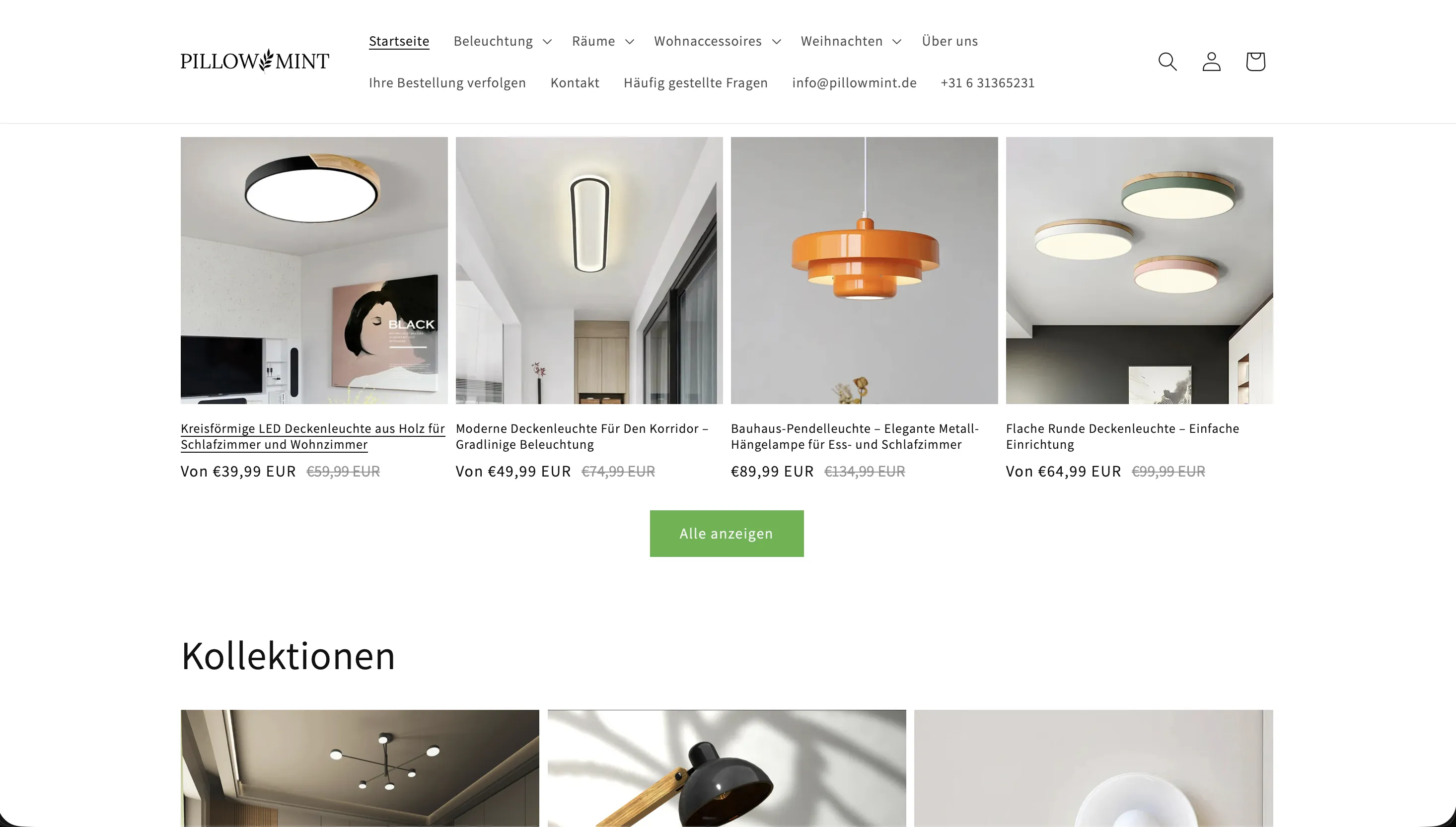
The Brief
Pillow Mint is a German home goods brand selling lighting, soft furnishings, and seasonal decor across Europe. The founder needed a custom Shopify build that could carry a wide product catalog without feeling cluttered, plus an operations partner to handle daily orders, supplier coordination, and customer support in German. We delivered the store and now run the back office.
Built for a wide catalog.
Pillow Mint carries hundreds of SKUs across lighting, pillows, throws, and seasonal lines. The custom storefront uses a clean grid system, fast filtering, and lazy-loaded imagery so even category pages with 100+ products feel instant. Page speed scores improved across the board after the rebuild.
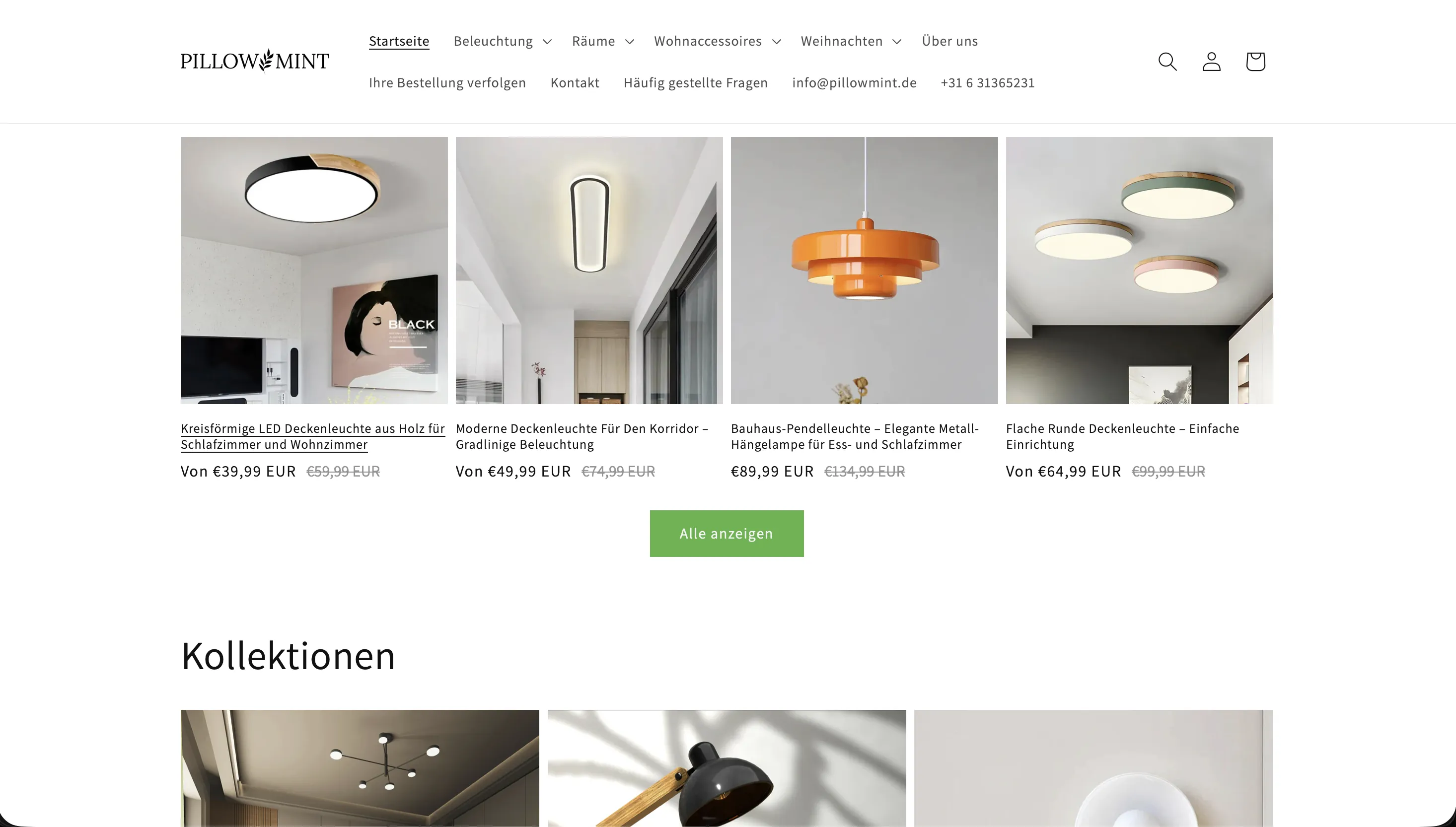
A homepage that rotates with the season.
Home goods commerce in Europe is heavily seasonal. The homepage we built rotates between four content compositions through the year: spring brightness, summer outdoor, autumn warmth, and winter holiday. The marketing team swaps each composition through Shopify metaobjects without touching theme code. The store always looks like it was designed for the moment it is selling into.
Filtering that helps buyers find their style.
A 500-SKU catalog without filtering is a discoverability problem disguised as a content strategy. We built a faceted filter system that lets buyers narrow by room (living, bedroom, dining, outdoor), by material (linen, cotton, wool, ceramic), by color family, and by price band. Filtered category pages render fast through pre-built URL patterns and lazy image loading.
Operations that handle the seasonal swing.
The operations team runs everything from order processing through supplier coordination and German-language customer support. The challenge is the dramatic seasonal swing: a slow August week looks nothing like a pre-Christmas week, and the staffing model has to flex accordingly. We pre-stage support coverage and exception-handling capacity ahead of each known seasonal moment so the brand never gets caught short.
Building and operating a high-SKU German home goods brand
Pillow Mint sells home goods across the German-speaking and broader European markets: lighting, soft furnishings, throws, ceramics, seasonal decor. The product range is wide by design, the brand operates across multiple currencies and languages, and the operational complexity scales with every new SKU. The founder needed a partner who could deliver a custom Shopify build that did not feel cluttered at scale, and an operations team that could run the back office while she focused on buying. We delivered both and now run the engagement on an ongoing retainer.
Why a high-SKU home goods catalog needs custom development
Most Shopify themes are designed for brands with 20 to 100 SKUs. They start to break visually and operationally past 200. By 500 SKUs you are fighting the theme more than working with it. Pillow Mint sits well past that threshold across its full catalog, which forced a custom build rather than a paid theme.
Specific problems we had to solve in the build that off-the-shelf themes do not handle well:
- Category page rendering speed at 100+ products. Even with lazy loading, naive Liquid rendering bottlenecks past a few dozen products. We built section rendering with chunked pagination and aggressive image lazy-loading so 100+ product category pages render fast on mobile.
- Faceted filtering without third-party app cost. Most stores in this size band rely on apps like Searchanise or Boost. We built the filter natively against Shopify's tag system so the brand does not pay app fees per order at scale.
- Multi-currency display across the EU. Customers in different markets see prices in their local currency without breaking the cache, using Shopify Markets configured with explicit pricing rather than auto-conversion.
- Seasonal content swap through metaobjects. Marketing-editable content blocks for seasonal moments without needing to deploy theme changes.
The operations layer
Operations work for a high-SKU home goods brand splits across roughly five workstreams that run continuously.
Order processing
Order volume varies dramatically by week. Slow weeks see a manageable steady flow. Pre-Christmas weeks see multiples of that volume. The team handles every order, processes exceptions (partial fulfillment, address corrections, gift orders, B2B sales for interior designers who buy in bulk), and ensures tracking updates flow back to customers in their preferred language.
Supplier coordination
Pillow Mint sources from a mix of manufacturing partners, each with its own lead time, minimum order and shipping cadence. Our team maintains the supplier directory, manages reorder triggers, handles invoice reconciliation, and escalates any supplier missing SLA. We also lead the QC process for seasonal drops where a single batch will sell through quickly and a quality issue would be operationally expensive to correct mid-season.
Customer support in German and English
Roughly two-thirds of support tickets arrive in German, one-third in English. Our specialist team handles both natively. Most tickets are practical: shipping inquiries, product specifications, gift orders, sizing questions on textiles. Some require more involved handling: defective lighting requiring replacement, color shade questions where the customer wants reassurance the product matches their home palette.
Returns processing
Home goods returns in Europe are common because the buyer often cannot evaluate the product fully until it arrives in their actual room. The returns flow is built to minimize friction: prepaid label generation, expected processing windows communicated clearly, and exchange suggestions for buyers whose primary issue is fit or fitment rather than defect. The brand voice in returns communications is calm and accommodating, never defensive, because the home goods buyer makes more returns than the fashion buyer and treating that as a problem rather than a feature creates churn.
Inventory coordination
The seasonal swing in home goods means inventory planning is harder than for a steady-state apparel brand. Lighting that sells through in November may not sell again until the following October. The team maintains a calendar of seasonal reorder points and works with the founder on which discontinued SKUs to phase out and which to reorder. Stockouts during peak season are operationally expensive; carrying overstock through low season is financially expensive. The right cadence between these requires constant attention.
The marketing partnership
While operations is the core engagement, we also handle the Klaviyo email and SMS program for Pillow Mint. The flow architecture matches the seasonal nature of the brand: welcome series for new signups, browse and cart abandon, post-purchase nurture, win-back, and seasonally-triggered campaigns for major moments. The campaign cadence aligns to the seasonal calendar rather than running at constant intensity year-round, which would burn out the list during slow months.
What we learned that applies to other home goods brands
Three patterns from the Pillow Mint engagement that we have since applied to similar engagements:
- High-SKU catalogs need custom development, not custom themes. The economics of working around theme limitations past 300 SKUs are worse than the cost of building correctly from the start.
- Seasonal staffing flexibility is operationally essential in home goods. Brands that staff for the average week will fail during peak weeks. Brands that staff for peak will overspend during slow weeks. The right answer is a flex model that scales coverage with the calendar.
- Returns are a feature of the category, not a problem. Brands that treat returns as a friction point to minimize generate worse customer relationships than brands that treat returns as part of the buying experience.
If you operate a home goods or interior brand and want to discuss what a similar build plus operations engagement would look like, book a free 30-minute discovery call.
Let's talk ecommerce, Shopify, and growth.
We are an operations-first Shopify agency that partners with brands to design, develop, support, and grow their stores. Tell us about your project.